During our trip through Jujuy, we decided to spend New Year’s Eve in Tilcara and use it as a base from which to explore the rest of the Quebrada. Tilcara is the town with the most infrastructure for tourism; it sits at 2,465 meters above sea level. It’s very easy to reach by car, but buses and taxis also run from San Salvador de Jujuy, which is about 85 km away.
The town of Tilcara centers around the main square, Manuel Álvarez, where a craft fair is held. Very close by is the Church of Our Lady of the Rosary, as well as the Archaeological Museum, the Museum of Paintings, and the Museum of Fine Arts. In the evenings, you can enjoy live folk music performances.
What to visit in the Quebrada
-
The Pucará of Tilcara:
It is the most important archaeological site in Argentina, covering an area of 15 hectares divided into different sectors. The Pucará served as a defense and settlement for the pre-Columbian inhabitants of the gorge. It is located 1 km from the town center on a 70-meter-high hill.
Important Information
Open daily from 9 a.m. to 6 p.m.
Admission Fees (2019)
General: $25
Foreigners: $50
Seniors and Groups: $10
Residents of Jujuy Province: free admission every day with valid ID
The ticket is valid for entry to the Pucará de Tilcara, the Archaeological Museum, and the High-Altitude Botanical Garden.
-
The Devil’s Throat:
This is a geological formation of breathtaking beauty; you can reach it by car or by walking along a dirt path. From there, you can enjoy beautiful landscapes, and after walking about 20 minutes along the riverbed, you’ll reach a lovely natural waterfall.
Taking National Route 9, we head toward Huacalera, a small town with a monolith dedicated to the Tropic of Capricorn, as the southern hemisphere’s tropic passes through that point; every year, the Inti Raymi or Festival of the Sun is held there.
Continuing north, we’ll reach the small town of Uquía, where we can visit various tourist attractions.
-
The Church of San Francisco de Paula:
Located across from the plaza, it was declared a National Historic Monument because its construction dates back to the late 17th century.
-
Takashi Takahashi Museum
-
Quebrada de las Señoritas:
From the town of Uquía, we take a hike to Quebrada de las Señoritas, a fantastic place with red hills, caves, and tectonic fissures.
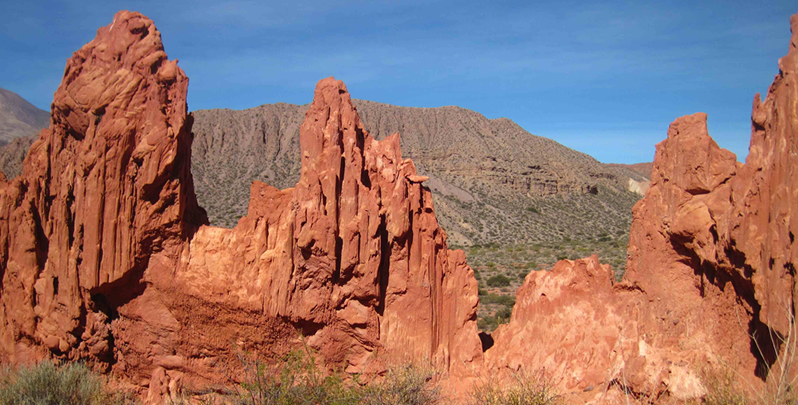
We continued north toward the town of Humahuaca. Situated at 3,000 meters above sea level, this town is surrounded by stunning mountain ranges. It offers various tourist services and is located 37 km from Tilcara and 128 km from San Salvador de Jujuy.
It is a picturesque town, ideal for exploring on foot through its narrow streets and admiring the various adobe houses and buildings. The town center is defined by its small, garden-like town square. Across from it stands the City Hall building, which features a tower where, every day at 12 noon sharp, a moving statue of San Francisco Solano appears. It’s incredible how many tourists wait to witness this local tradition.
-
Monument to Independence
Framed by a steep staircase on Santa Barbara Hill, facing the main square. It represents the numerous struggles for independence
-
El Hornocal
Leaving the city of Humahuaca, cross the Río Grande via the bridge near the bus terminal. Take Provincial Route 73 toward Santa Ana; it’s about 25 kilometers of gravel road until you reach the Hornocal mountain range.
It is advisable to drive slowly and keep in mind that the climb is continuous, reaching an altitude of 4,200 meters.
"We feel insignificant in the face of such natural beauty."
Upon arrival, you can descend to get a better view of the landscape. It is an example of stratified sedimentation, with colors formed by limestone ranging from ochre to green, yellow, and even white. These strata were underground thousands of years ago, when the formation of the mountain range, through its long process, exposed the colors. Today, we see the fractured rocks framing the panoramic views.
We particularly recommend arriving in the afternoon when the sun will highlight the colors even more.
-
Peñas Blancas
This site is located in the northern sector of the Quebrada de Humahuaca. To get there, cross the city bridge and continue through the La Banda neighborhood. This route can be done on foot or by car. Then you climb a steep trail to the summit, and from there you can explore the site, which is quite extensive and requires time to fully appreciate its full scope. From there, you can see the entire Quebrada.
Another place to visit is the town of Iruya; although we couldn’t get there because we went during the rainy season and access is difficult due to the swollen rivers, we highly recommend it.
Iruya is a town in Salta, but it can only be accessed from the province of Jujuy; it is located 74 kilometers from the Quebrada de Humahuaca. It is known as a town that seems to descend from the sky or the mountains, and it sits at 2,780 meters above sea level.
On the way to Purmamarca, we passed through Maimará, located just 5 km from Tilcara, a quiet town with colorful mountains in the foreground.
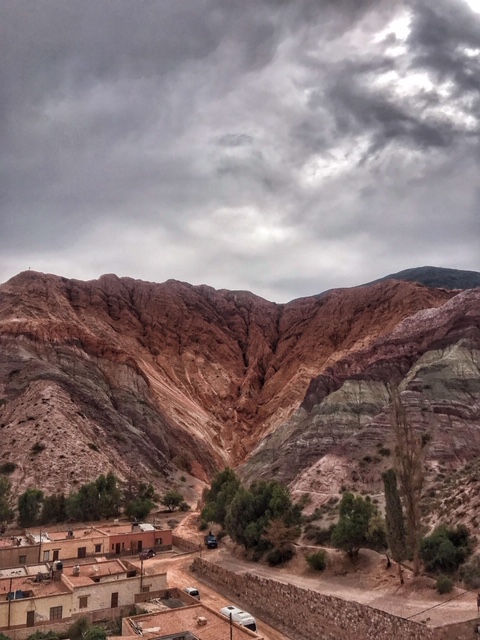
We continue on to Purmamarca, the “Town of the Virgin Land,” located at the foot of the Hill of Seven Colors. It is a peaceful town, ideal for relaxation. It preserves the colonial architecture, customs, and traditions of the Quebrada villages. It is located on National Route 52, 66 km from San Salvador de Jujuy, at 2,324 meters above sea level. You can explore the town on foot, and a craft fair is held every day in the main square.
-
The Church of Santa Rosa de Lima
-
The colonial town hall, which currently houses the “Viltipico” Public Library
-
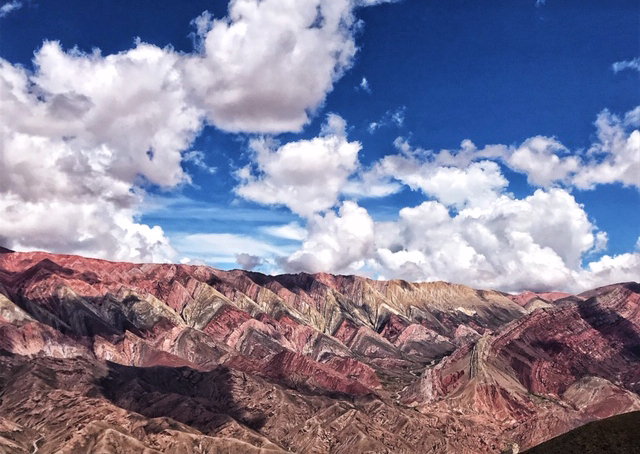
Hill of the Seven Colors
Famous for the hues of color created by the different minerals on its uniquely beautiful slope, it can be seen from the street that starts at the main square and from various scenic viewpoints in the town.
-
Paseo de los Colorados
This is a 3-km loop that can be done on foot or by car; we recommend walking to enjoy the stunning landscapes and geological formations.
To wrap up our stay in Jujuy, we set out from Purmamarca toward La Cuesta del Lipán, a beautiful stretch of National Route 52 that heads toward Paso de Jama on the border with Chile; the road is in excellent condition. There we reached an elevation of about 4,170 meters above sea level, and as we descended, we arrived at Salinas Grandes. On the side of the road is a rest stop for visitors, with parking and a market selling handicrafts. The salt flat workers serve as guides and escorts.
The salt flats feature large pools from which workers extract the salt that is later sold.
We recommend bringing snacks and fruit, as there is nowhere nearby to eat.
Where to Stay in Tilcara
We had a pleasant stay at the Posada de Uriel, located 100 meters from Antonio Peloq Square. It offers rooms with free Wi-Fi and cable TV. The place is comfortable and quiet, ideal for relaxing and enjoying a good barbecue.
Here’s the link in case you want to book and get a $15 refund on your next trip through Booking: https://www.booking.com/s/73_6/33e36da9
Where to Eat in Tilcara
La Peña de Carlitos has a very varied menu and delicious food; they have folk music shows every day and don’t charge a cover charge.
Without a doubt, the grilled street tortillas are a great lunch option when you want something tasty, quick, and cheap.
Follow our travels on social media!!!