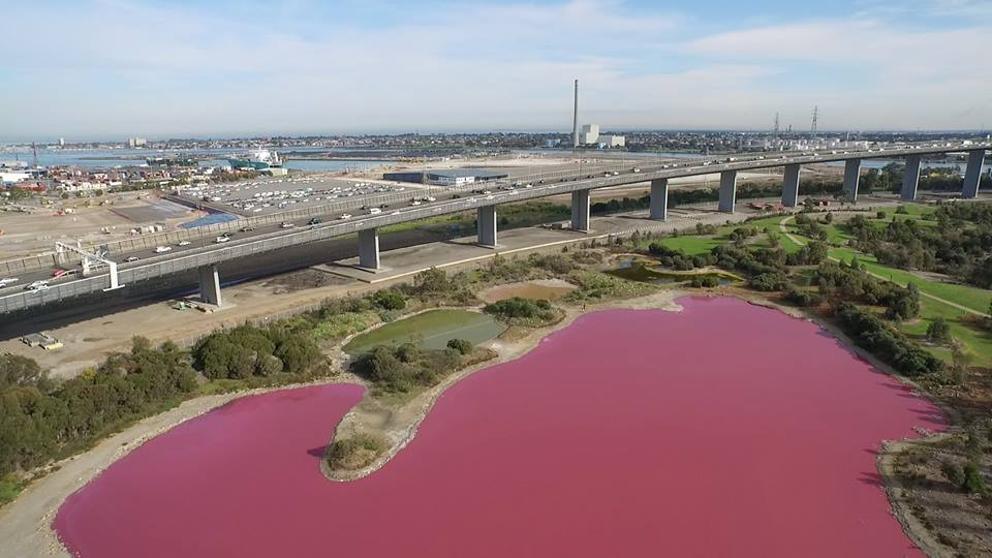
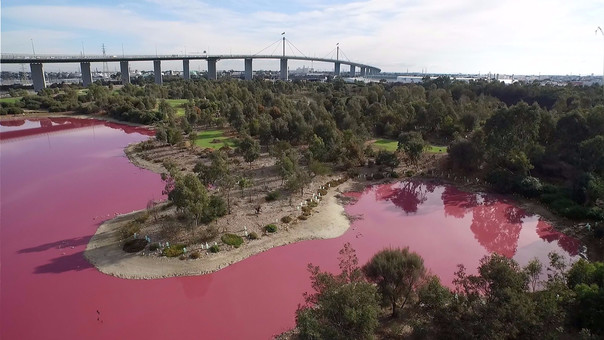
The lake in Westgate Park in Melbourne, Australia, has had an unusual appearance for the past few weeks: its waters have turned pink. But Australians aren’t surprised, as this happens every year around summertime and has a scientific explanation.
When summer arrives and temperatures rise, the water in this lake becomes particularly salty. Its salinity levels exceed those of the sea by a factor of ten and occur after the water evaporates due to the heat of the environment.
Pigmentation. Amid this phenomenon, a microbe capable of surviving in this habitat begins to reproduce massively and produces pink pigments called carotenoids. This effect will gradually fade by June as the weather cools and winter arrives.
Mark Norman, a conservation biologist with Parks Victoria, explains that it is not enough for the lake to be highly salty for its waters to turn pink under the conditions described. As he told The New York Times, there must be a balanced combination of factors: high salinity, the right type of salt, and the right organisms.
OTHER CASES AROUND THE WORLD
What happened in Australia also occurs in other parts of the world. Spain (Las Salinas de Torrevieja) and Bolivia (Laguna Colorada) are countries where this phenomenon is not uncommon. Others, such as Senegal, Azerbaijan, Tanzania, Kenya, and Mexico, also have their own seasonal versions.
Follow us on social media!!!